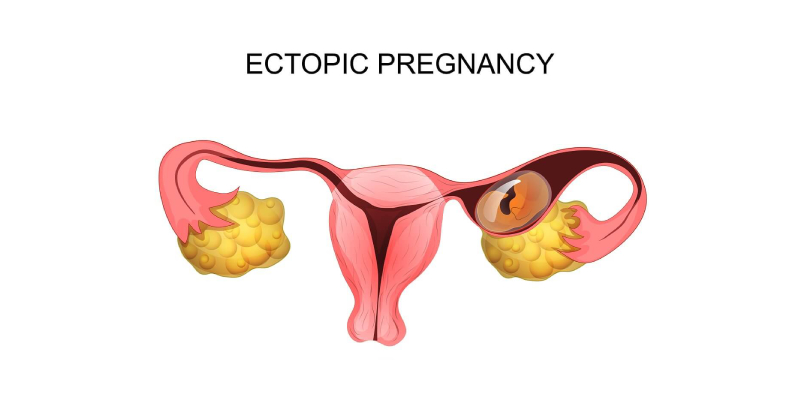
An ectopic pregnancy happens when the fertilised egg gets implanted outside the uterus, most commonly in the fallopian tube, but it can happen in the ovaries or anywhere outside the uterus. It cannot grow normally and can become dangerous if not treated on time. Early recognition is the key to preventing complications.
This simple Q&A will help you understand the condition, its symptoms, and when to seek medical help.
1. Why does an ectopic pregnancy happen? What are the high-risk factors?
It usually occurs due to blockage or damage in the fallopian tube. High-risk factors include:
- Previous ectopic pregnancy
- History of pelvic infections
- Prior tubal surgery
- IVF
- Smoking
- Endometriosis
2. Can I do anything to avoid it?
You can reduce your risk by treating infections early, avoiding smoking, and managing any pelvic or tubal problems promptly.
Do an ultrasound as soon as your pregnancy test is positive to diagnose an ectopic pregnancy early.
Seek medical help as soon as you notice one-sided pain, spotting, or dizziness, especially if you recently missed a period.
An early ultrasound and β-hCG test are the fastest ways to detect an ectopic.
3. What is the treatment for ectopic pregnancy?
Stable cases may be treated with medication (methotrexate).
Surgery is needed if the tube has ruptured or if the patient is unstable.
4. Do all ectopic pregnancies require surgery?
No. Stable cases can be treated with methotrexate.
Surgery is needed if the tube is at risk of rupturing or if the woman is vitally unstable.
5. What surgery is done for an ectopic pregnancy? Can I conceive naturally afterward?
Surgery is usually done laparoscopically. Depending on the situation, the doctor may:
- Remove the affected tube (salpingectomy), or
- Try to save it (salpingostomy)
Most women can still conceive naturally later with the remaining tube.
6. Will there be complications if I get treatment late or leave it untreated?
Yes. Untreated ectopic pregnancy can lead to:
- Tube rupture
- Internal bleeding
- Severe abdominal pain
- Life-threatening shock
Early treatment prevents these complications.
7. Can an ectopic pregnancy be prevented?
Not always, but reducing risk factors such as treating infections early, avoiding smoking, and managing previous pelvic issues helps.
8. Does an ectopic pregnancy require many follow-ups?
Follow-ups are extremely important, especially if treated with methotrexate, to ensure the pregnancy hormone (β-hCG) returns to zero.
Surgical cases also need 1–2 check-ups to confirm healing.
Missing follow-ups can lead to grave complications.
9. If I’ve had an ectopic pregnancy before, does my chance of another one increase?
Yes, the risk is slightly higher than average, but you can still go on to have completely normal pregnancies. Early scans in the next pregnancy are essential.
10. Will an ectopic pregnancy affect my fertility?
Most women can conceive again, even with one tube.
Fertility depends on the health of the remaining tube and overall reproductive health.
Try for pregnancy only after your doctor gives clearance, usually after 2–3 months. Early scans in the next pregnancy are important.
💡 Final Words:
- Get an ultrasound as soon as your pregnancy test is positive to detect any pregnancy early.
- Watch for warning signs—one-sided pain, spotting, dizziness, shoulder pain, or feeling faint.
- Never skip follow-ups; missing them can lead to dangerous, life-threatening complications.
- With early diagnosis and timely treatment, most women recover well and can have healthy pregnancies in the future.
📍 Source: Dr. Shweta Mehta – DNB, Obstetrics & Gynaecology | United Multispeciality Hospital, Kandivali West, Mumbai.